By Joseph Greenspan, First Fidelity Home Mortgage of Wisconsin, LLC
November 19, 2026 | Wisconsin Housing & Mortgage Market Analysis
New housing data released today reveals a troubling contradiction in Wisconsin's real estate market.
Home sales are declining, mortgage interest rates remain elevated, and housing affordability continues to deteriorate. Yet despite weaker buyer demand, home prices are still increasing.
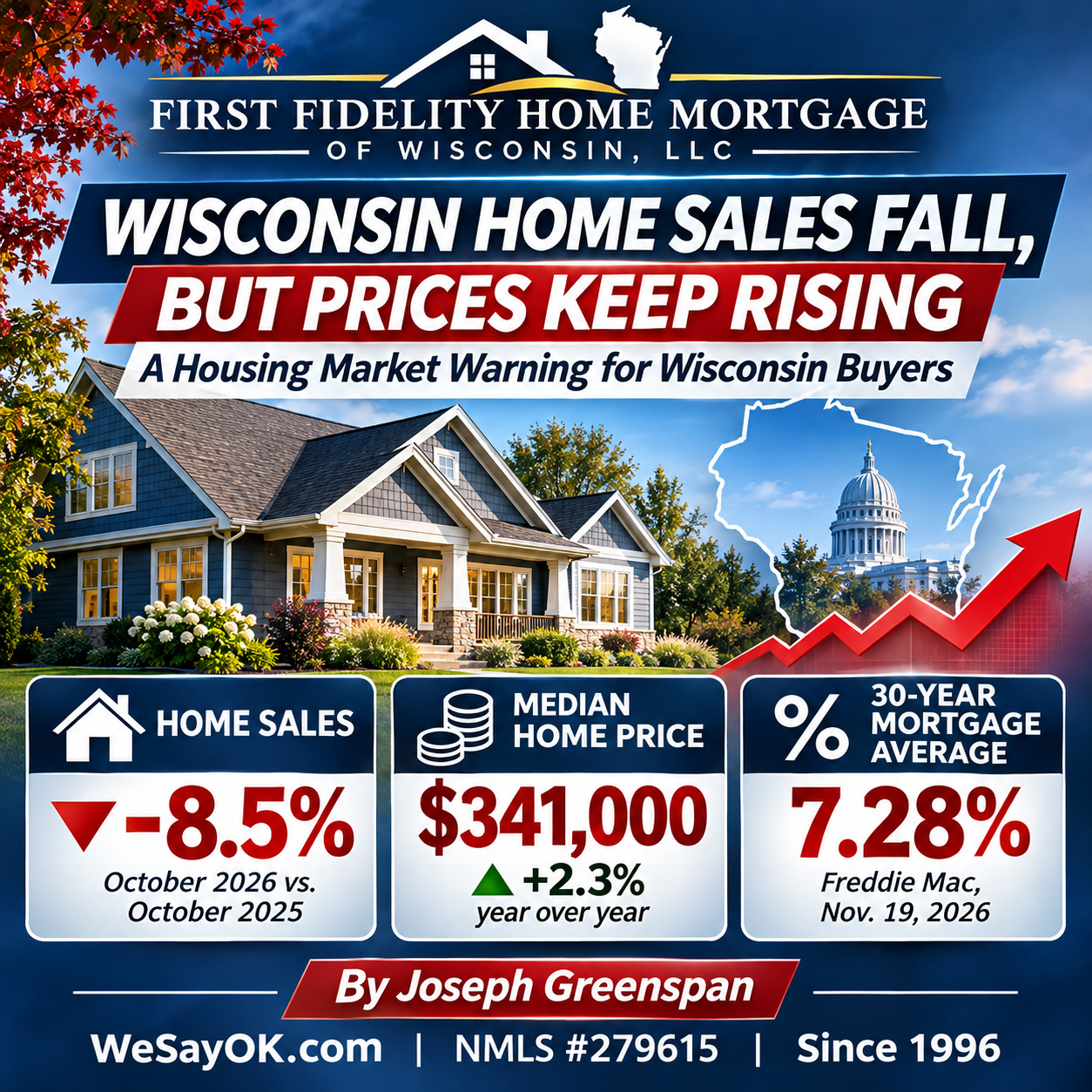
According to the Wisconsin REALTORS® Association's October 2026 housing report, existing home sales declined 8.5% compared with October of last year.
At the same time, the median home price increased 2.3%, reaching $341,000.
That raises an important question.
If fewer people are buying homes, why aren't prices falling?
The answer involves housing supply, affordability, and a market that is adjusting to higher borrowing costs.
Freddie Mac reported today that the average 30-year fixed mortgage rate increased to 7.28%, up from 7.11% the previous week.
For comparison, the average was 6.26% one year ago.
These higher rates have a direct impact on how much homebuyers can afford.
Consider a $300,000 mortgage.
At a 6.25% interest rate, the monthly principal and interest payment would be approximately $1,847.
At 7.25%, that payment increases to approximately $2,047.
That's an additional $200 per month, or roughly $2,400 annually, without purchasing a more expensive home.
These examples exclude property taxes, homeowners insurance, mortgage insurance, and other applicable housing expenses.
For many Wisconsin families, that difference is significant.
Higher borrowing costs are forcing buyers to reconsider price ranges, delay purchases, or search for alternative financing strategies.
Under normal economic conditions, reduced demand often puts downward pressure on prices.
Housing, however, is not a typical commodity.
Homeowners who purchased or refinanced when mortgage rates were significantly lower may be reluctant to sell and give up their existing financing.
Meanwhile, new construction has faced challenges from borrowing costs, labor expenses, and uncertain demand.
The result is a market in which demand has weakened, but the supply of homes available in desirable locations may still be insufficient.
Wisconsin's October report shows total listings increased 6.1% from a year earlier, even though new listings declined 5.8%.
Homes are also taking longer to sell.
That tells me the market is becoming more negotiable in some areas, but it does not necessarily mean sellers are prepared to make substantial price reductions.
Perhaps the most concerning finding in the October housing report is the deterioration in affordability.
The Wisconsin REALTORS® Association reported that housing affordability declined 12.2% over the past year.
Its Housing Affordability Index has now reached its lowest level since the organization began tracking the measure in 2009.
That is an important warning.
Homeownership should not be evaluated solely by whether a buyer qualifies for a mortgage.
The real question is whether the household can comfortably manage the payment while maintaining financial flexibility.
Higher mortgage rates, property taxes, insurance costs, and everyday living expenses all influence that decision.
Despite these challenges, today's housing market may offer some opportunities that were difficult to find during periods of intense buyer competition.
With homes remaining on the market longer, some sellers may be more receptive to negotiations.
Depending on the transaction, buyers may be able to negotiate:
Seller contributions toward allowable closing costs.
Temporary or permanent mortgage interest rate buydowns.
Purchase price adjustments.
Repair credits or other negotiated contract terms.
Financing through eligible down payment assistance programs.
The important point is that a lower advertised interest rate isn't always the only way to improve the economics of purchasing a home.
Sometimes the structure of the transaction can make a meaningful difference.
This is one of the most important questions facing prospective buyers.
Waiting could make sense for someone who needs additional savings, greater job stability, or a more affordable monthly payment.
But there is another consideration.
If mortgage rates eventually decline, more buyers may return to the housing market.
In communities where housing inventory remains limited, stronger demand could increase competition and potentially push prices higher.
That outcome is not guaranteed. Home prices can decline, and lower mortgage rates do not ensure greater demand.
My recommendation is to focus on the total financial picture rather than attempting to predict the perfect moment to buy.
A home purchase should make sense based on today's finances, without depending on a future refinance or expected appreciation.
I believe three factors deserve close attention over the next several months.
First, inflation and the bond market will continue to influence mortgage rates. A sustained improvement in inflation could eventually support more favorable borrowing conditions, while stubborn inflation could keep rates elevated.
Second, housing inventory needs to be monitored locally. Statewide statistics are useful, but conditions in Waukesha County, Milwaukee County, Dane County, and smaller Wisconsin communities can be very different.
Third, buyers and sellers will need to adjust their expectations. A market with fewer transactions does not automatically become a market with dramatically lower prices.
The biggest risk to Wisconsin housing may not be a sudden price collapse. It may be a prolonged period in which homeownership remains financially out of reach for too many households.
That would affect buyers, sellers, homebuilders, and the broader Wisconsin economy.
I have worked through multiple real estate and mortgage cycles, including periods of rapidly rising rates, falling home values, and unusually competitive housing markets.
One thing I have learned is that consumers benefit from understanding the reasons behind changing market conditions.
At First Fidelity Home Mortgage of Wisconsin, LLC, our focus is helping borrowers evaluate their options and make informed decisions.
We've been serving Wisconsin since 1996, providing the personal attention of a local mortgage team from the beginning of the financing process through closing.
If you're considering buying a home, refinancing, or exploring your financing options, we welcome the opportunity to help.
First Fidelity Home Mortgage of Wisconsin, LLC
We Say OK.
NMLS #279615
Sources: Wisconsin REALTORS® Association, October 2026 Home Sales Report, released November 19, 2026; Freddie Mac Primary Mortgage Market Survey, November 19, 2026.
This article provides general market commentary and educational information. Market projections are opinions, not guarantees. Mortgage rates and terms vary by borrower, property, and program. All financing is subject to applicable qualifications and underwriting requirements.